Source: The Globe and Mail
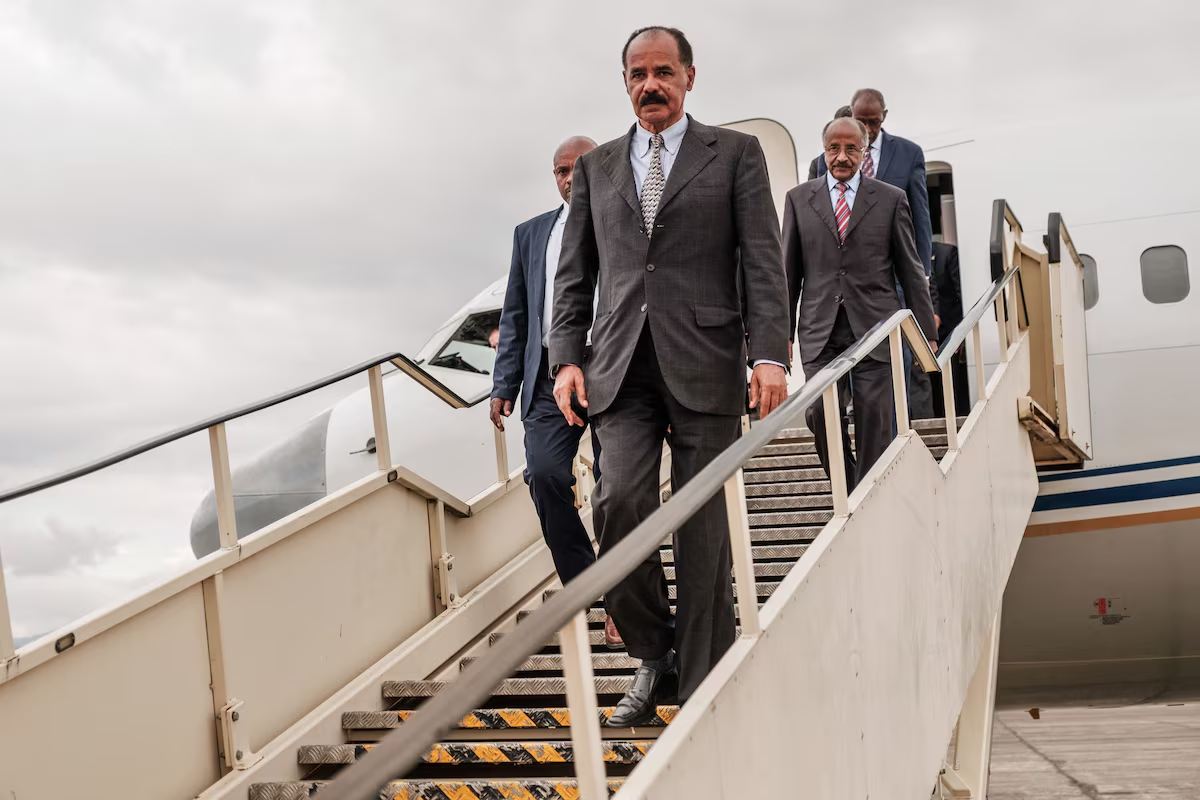
Eritrea’s President Isaias Afwerki steps down from the aircraft at the airport in Gondar, for a visit to Ethiopia, November, 2018. Mr. Afwerki, has ruled Eritrea without challenge for 33 years.
The isolated regime of Eritrea, long shunned as one of the world’s most repressive dictatorships, is enjoying a sudden flurry of diplomatic attention from Western governments that increasingly value its strategic location on the Red Sea.
The courting of Eritrea is the latest sign that the West is downplaying its traditional human-rights concerns in the Horn of Africa and instead prioritizing geopolitical factors such as shipping routes and military muscle in volatile regions.
The United States and the European Union imposed sanctions on Eritrean officials in 2021 in response to the regime’s military incursion into northern Ethiopia, where its troops have massacred civilians. But U.S. and EU envoys − along with a Canadian ambassador – have been visiting Eritrea and meeting with officials in recent weeks, even though its soldiers are still entrenched in Ethiopia.
The visits are part of a “diplomatic stampede to Eritrea,” according to Cameron Hudson, a U.S.-based Africa analyst and former U.S. official.
Critics are questioning the Western strategy, warning that it would sacrifice human-rights concerns in exchange for unclear benefits. It could also inflict spillover damage on conflicts in Ethiopia and Sudan, they said.
Eritrea is often described as the North Korea of Africa. It has banned political parties and independent media, refused to hold elections since its independence in 1993 and imposed a vast system of conscription that forces citizens into military service for indefinite terms. Its autocratic leader, Isaias Afwerki, has ruled the country without challenge for 33 years.
But now the West seems ready to let Eritrea come in from the cold. The main reason for the surge of flattering rhetoric and official meetings, according to analysts, is Eritrea’s control of almost 1,200 kilometres of Red Sea coastline, at a time when the U.S.-Israeli war on Iran has severely restricted shipping traffic on the other side of the Arabian Peninsula, in the Strait of Hormuz.
Why the Strait of Hormuz has been a global commerce chokepoint for centuries
The Red Sea route is becoming increasingly important as the conflict continues. There are fears that the Houthis, an Iran-backed militia in Yemen, could attack ships in the Red Sea, disrupting another key route for oil supplies.
Some of the Western diplomatic efforts in Eritrea, however, began before the Iran crisis, signalling a broader interest in its usefulness in the increasingly contested Red Sea and Horn of Africa regions.
A senior U.S. envoy, Massad Boulos, has met with Eritrean leaders in recent months and suggested privately that Washington may be willing to lift its sanctions, according to a Wall Street Journal report.
He is not the only one reaching out. An EU envoy, Annette Weber, visited the Eritrean capital, Asmara, in late March. In a statement, she said she was “delighted” by the “engaging and constructive discussions” with Eritrean officials on regional issues.
Middle East war could force Gulf states to pivot from Africa
Canada’s high commissioner to Kenya, Joshua Tabah, who is accredited to Eritrea, travelled to Asmara in mid-April. He said his goal was “to put Canada-Eritrea relations on a more solid footing and to look for mutually beneficial partnerships.”
In a social media post later, Mr. Tabah said he had “extensive discussion” with Eritrean Foreign Affairs Minister Osman Saleh Mohammed on “regional dynamics.” He said the interests of Canada and Eritrea were “aligned” on some issues, including a shared commitment to “sovereignty and territorial integrity.”
Nicholas Coghlan, a former senior Canadian diplomat in the Horn of Africa, said Mr. Tabah’s comments were perplexingly positive. He questioned the suggestion of aligned interests, noting that Canada’s official policy on Eritrea, according to the Global Affairs Canada website, is still focused primarily on human rights and the need for Eritrea to withdraw its troops from Ethiopia.
With arms shipments and military training, Russia deepens its influence across Africa
While a handful of political prisoners were released in late 2025, the United Nations estimates there are still 10,000 arbitrarily detained prisoners in Eritrea, including politicians, journalists, priests and students.
“There has been no discernible improvement in Eritrea’s human-rights record,” Mr. Coghlan told The Globe and Mail. “Those Eritrean troops are still in Ethiopia, and bilateral tension with Ethiopia is hotter than ever.”
Trade between Canada and Eritrea is negligible, he noted. “It’s difficult to see what Canada has to gain by a warming of this particular relationship.”
Susanne Berger, a senior fellow at the Raoul Wallenberg Centre for Human Rights, said the shift in Western policy toward Eritrea is deeply concerning. “It ultimately constitutes a clear move away from a principled, value-based foreign policy approach to one that almost exclusively prioritizes national interests,” she told The Globe.
“If you signal to autocrats that they have nothing to fear, they do not become more malleable. Instead, they become emboldened.”
Analysts are worried that a Western rapprochement with Eritrea will fuel conflicts in Sudan and Ethiopia. It could “simultaneously embolden Asmara on two fronts − against Addis Ababa and in its alignment with the Sudanese Armed Forces − at a moment when the collision course is most live,” Africa-based research group Sahan said in a report Tuesday.