Source: Geeska
The Trump administration is considering steps to improve relations with Eritrea as security concerns grow in key global shipping routes.
U.S. Senior Advisor for Arab and African Affairs Massad Boulos has told foreign counterparts that Washington is considering lifting some sanctions on Eritrea, The Wall Street Journal reported, citing current and former officials familiar with the matter. The effort is part of a broader push to restore higher-level diplomatic ties after decades of limited engagement, though officials say the plan remains under review. According to the Wall Street Journal, the diplomatic outreach comes as the Iran-backed Houthi movement has threatened to disrupt maritime traffic in the Red Sea.
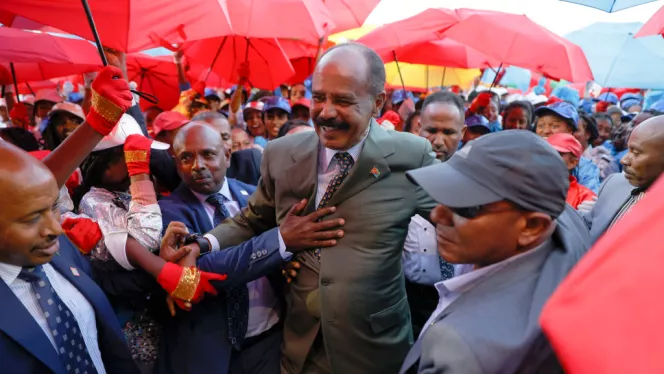
The Wall Street Journal reported that Boulos met Eritrean President Isaias Afwerki in Cairo late last year to discuss easing sanctions and reopening dialogue. Egypt has played a mediating role in the talks. More recently, Boulos also met Egyptian President Abdel Fattah el-Sisi, where he indicated that the U.S. could soon begin lifting some sanctions, according to officials cited by the newspaper. The envoy previously held discussions with Eritrean Foreign Minister Osman Saleh Mohammed on the sidelines of the United Nations General Assembly. A spokesperson for the U.S. Department of State said Washington is interested in strengthening ties with Eritrea but declined to comment on specific sanctions measures.
This outreach comes at a critical moment, as the United States and its key ally, Israel, face mounting strategic challenges in their confrontation with Iran. Recent developments have altered the regional balance, particularly with Iran’s closure of the Strait of Hormuz, a vital artery for global energy shipments. In response, the Trump administration has pursued its own restrictive measures affecting maritime movement, including imposing a blockade.
At the same time, the Houthi movement has escalated its threats in the Red Sea, building on actions first seen during the war in Gaza Strip, when it targeted vessels linked to the United States and Israel. As the conflict with Iran has expanded, these disruptions have forced Washington to explore alternative maritime and logistical routes.
Consequently, the Red Sea littoral states have become increasingly strategic to U.S. planning and military posture, and Eritrea stands out as a particularly significant, if controversial, partner. Long isolated due to its authoritarian governance and history of sanctions, Eritrea nonetheless occupies a critical geographic position along the Red Sea.
The Trump administration, widely perceived as placing less emphasis on human rights considerations in foreign policy, may view Eritrea as a pragmatic opportunity to secure access and influence in this vital corridor.
However, renewed engagement between Washington and Asmara risks further complicating an already complex regional geopolitical landscape. Tensions between Eritrea and Ethiopia have been rising, particularly over the question of access to the sea. Under the leadership of Abiy Ahmed, Ethiopia has increasingly signaled its strategic interest in securing reliable Red Sea access, an ambition that Eritrea interprets as a direct challenge to its sovereignty.
This growing rivalry has pushed both countries toward the brink of renewed conflict. Adding to the instability are persistent accusations that Eritrea has supported and armed non-state actors within Ethiopia.
The outreach by the Trump administration now offers a form of strategic leverage for Isaias Afwerki, who is increasingly facing both internal and external pressures. Despite maintaining power for decades, Afwerki’s government is showing signs of strain, as prolonged economic isolation and structural constraints begin to expose internal vulnerabilities. Engagement with Washington, therefore, presents Eritrea with a potential pathway to ease sanctions and reduce its diplomatic isolation.