Source: devex.com
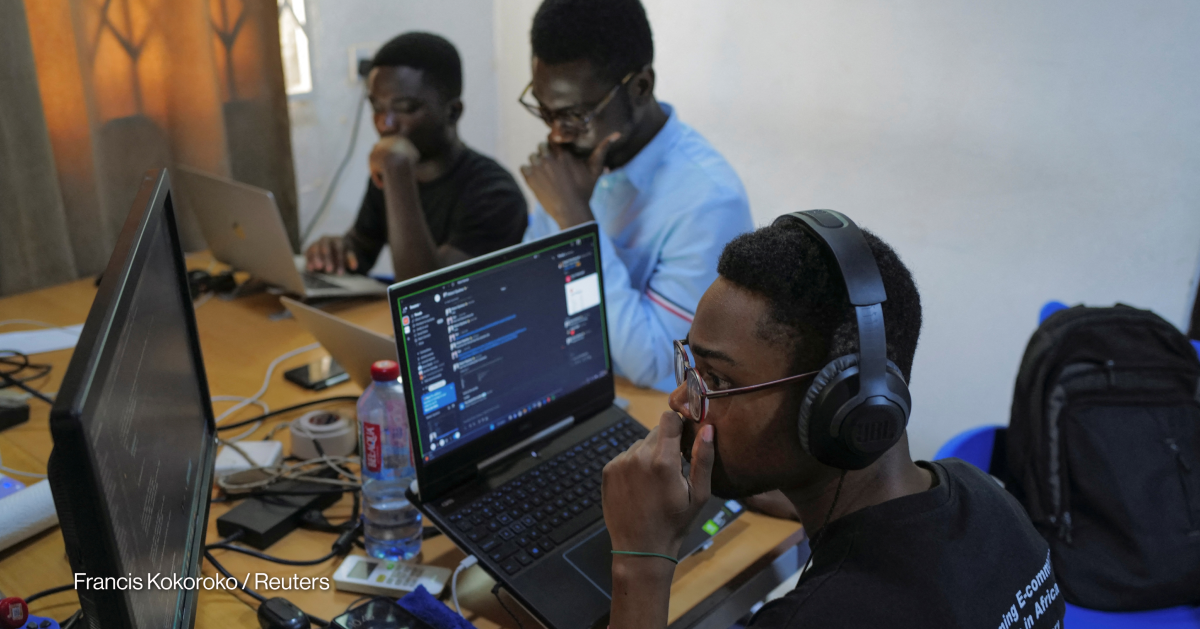
2025 may have been the year that development aid started to unravel. But it also marked a sharp rebound in funding for startups across Africa.
Startups raised $3.42 billion last year — a strong recovery after two years of pullback as global capital tightened. Zoom out and the shift is even clearer: More than $20 billion has flowed into African startups over the past seven years, according to African tech publication TechCabal.
Some of that money is landing with a familiar set of names. Optasia, a listed company in South Africa which builds credit infrastructure for telecoms and banks, raised $345 million in 2025 — one of the largest rounds of the year. Kenya’s Sun King continues to scale its pay-as-you-go solar model across multiple markets. Senegal-based Wave raised $137 million last year, enabling it to continue to expand aggressively across the continent.
This is no longer a thin pipeline of experiments. It is a real market — with scale, repeat investors, and companies operating across borders.
But as startups take on a more central role in the private sector story, the question is not just whether capital is flowing, but what impact is it having?
Is it creating jobs at scale? Moving workers into more productive parts of the economy? Expanding access to essential services in ways that last?
“This is a question I have pondered for the better part of two decades,” Ghanaian policy activist and entrepreneur Bright Simons tells me.
Despite years of startup growth, most African economies remain dominated by low-productivity, informal work — and that hasn’t shifted in any meaningful way. In his view, that’s the core disconnect: startups are scaling, but they are not yet functioning as a pathway into more productive, formal employment.
Simons’ argument is not that startups don’t matter. It’s that the kind of companies attracting capital — and the ecosystem around them — are not yet set up to drive broader economic transformation.
Unsexy and unglamorous
If you want to see where the development impact is actually happening, Simons argues, you have to “follow the unglamorous money.”
“The companies quietly rewriting African development aren’t the ones on the sexy podcasts,” he says.
Instead, he points to firms building the underlying systems others rely on — payments infrastructure, logistics networks, regulatory frameworks — what he describes as the “institutional microflora” of an economy.
These are the companies that make it easier for others to operate, scale, and create productivity gains — even if they are slower, less visible, and a poorer fit for traditional venture capital. That also shifts what “success” should look like.
Simons argues the emphasis shouldn’t be on chasing unicorns, or fast-scaling companies chasing billion-dollar valuations and quick exits.
At the Sankalp Forum in Nairobi, Kenya, earlier this year, a related question kept coming up: Should Africa be chasing something more durable, like a camel? The refrain, increasingly, was that yes, the end goal should be companies built for tougher conditions. Slower growth, earlier cash flow, more operational depth.
That argument often gets pushed even further: that Africa shouldn’t be focused on startups at all, and that growth will be driven primarily by small and medium-sized enterprises, or SMEs.
But that framing is incomplete, argues Klyne Maharaj, a partner at Baobab Network, a Kenya-based startup accelerator.
“Some of the most exciting African startups are building tools, platforms, and infrastructure for SMEs, and their growth is directly tied to SME growth,” he writes. In other words, the role of startups is less about replacing SMEs, and more about increasing their productivity.
For Simons, that points to a broader rethink.
“The real question … can’t be about how to manufacture unicorns,” he says. Instead, he argues, the focus should be on building “coral reef ecosystems” — dense networks of firms that reinforce one another and deepen markets over time.
Angels to the rescue
That raises yet another, related question: Who is actually writing the first checks?
A lot of the capital flowing into African startups still comes from outside the continent — venture firms, development finance institutions, and impact investors. They tend to come in once a company has some traction, and they tend to look for models that can scale quickly and return capital on a defined timeline.
But that’s not where most companies start.
At the earliest stages — when a founder is still testing an idea, refining a model, or building something that doesn’t yet look like a venture-backed business — the investors are often individuals: former founders, operators, professionals with sector expertise. They write smaller checks, sometimes pooling money together to back a company before it’s “ready.”
These are angel investors — and in 2025, they accounted for the highest number of deals on the continent, meaning they may not write the biggest checks, but they write most of them. What they’re funding, and how they’re funding it, shapes what gets built.
One effort to expand that layer is the African Angel Academy, which is training both African and diaspora investors to write those early checks.
Fiona Kiruja, a program manager at the academy, described it as an attempt to address a persistent gap in the ecosystem — not just a lack of capital, but a lack of people equipped to deploy it at the earliest stages.
“There was always that missing gap around the understanding of the fundamentals around angel investing,” she tells me.
The program takes investors through how to source deals, assess companies, structure investments, and support founders after the check is written. Along the way, they review actual startups — and in some cases, invest together through syndicates, pooling smaller amounts into a single round.
More than 800 investors have gone through the program so far, backing companies across more than 30 countries. Companies they have invested in include Afyalishe Wellness, which produces health foods in Kenya such as chia seeds and probiotic drinks.
The ambition now is to scale that base — not just in numbers, but in consistency.
Kiruja says the goal is to build a pipeline of investors who are regularly writing checks, staying engaged with founders, and backing companies across sectors and geographies — rather than relying on a small, concentrated set of networks.
If that layer deepens, it could start to change not just how African startups are funded — but what kinds of companies get built in the first place.
Read more: Filling Africa’s early-stage funding gap, one angel investor at a time
Growth outlook downgraded
If global investors start pulling back, local capital may matter more than ever.
A new World Bank report suggests that shift may already be underway. The U.S.-Israeli war with Iran is already pushing up energy prices, causing fuel inflation, and tightening global financial conditions — the kind of shock that typically triggers a flight to safety, as investors move money out of riskier markets.
In the report released yesterday, the World Bank warns that African growth in 2026 is now projected at 4.1% in 2026 — a 0.3 percentage point downgrade from earlier forecasts, and flat compared to 2025.
The investors most likely to pull back as global conditions tighten include Gulf countries — which have become an increasingly important source of capital across parts of the continent. “Their revenue sources are completely constrained, and even after the war, they may actually prioritize internal reconstruction,” says Andrew Dabalen, the World Bank’s chief economist for Africa. “So whether these investments are going to keep flowing or not is completely uncertain.”
The effects will be uneven. Some African countries — particularly oil exporters — could benefit from higher prices. But for others, the pressures are likely to be more acute, especially those heavily reliant on imported fuel, Dabalen warns.
At the same time, remittances — a critical source of income in many economies — could come under pressure if demand for workers in the Middle East weakens, while governments facing rising debt servicing costs have little room to cushion the shock.
For many countries, that leaves very little margin for error — and little control over what comes next. What they do still control, however, is how they respond.
“We can talk a lot about how countries can do that, but this is an incredibly dangerous moment,” says Dabalen, pointing to the importance of maintaining stability even as the shock unfolds.
“We have hope that African countries have now learned how to manage crises of this kind. This has been two decades of crises, so we are hopeful that, in fact, they have learned how to manage these kinds of crises, and will be able to recover sooner.”