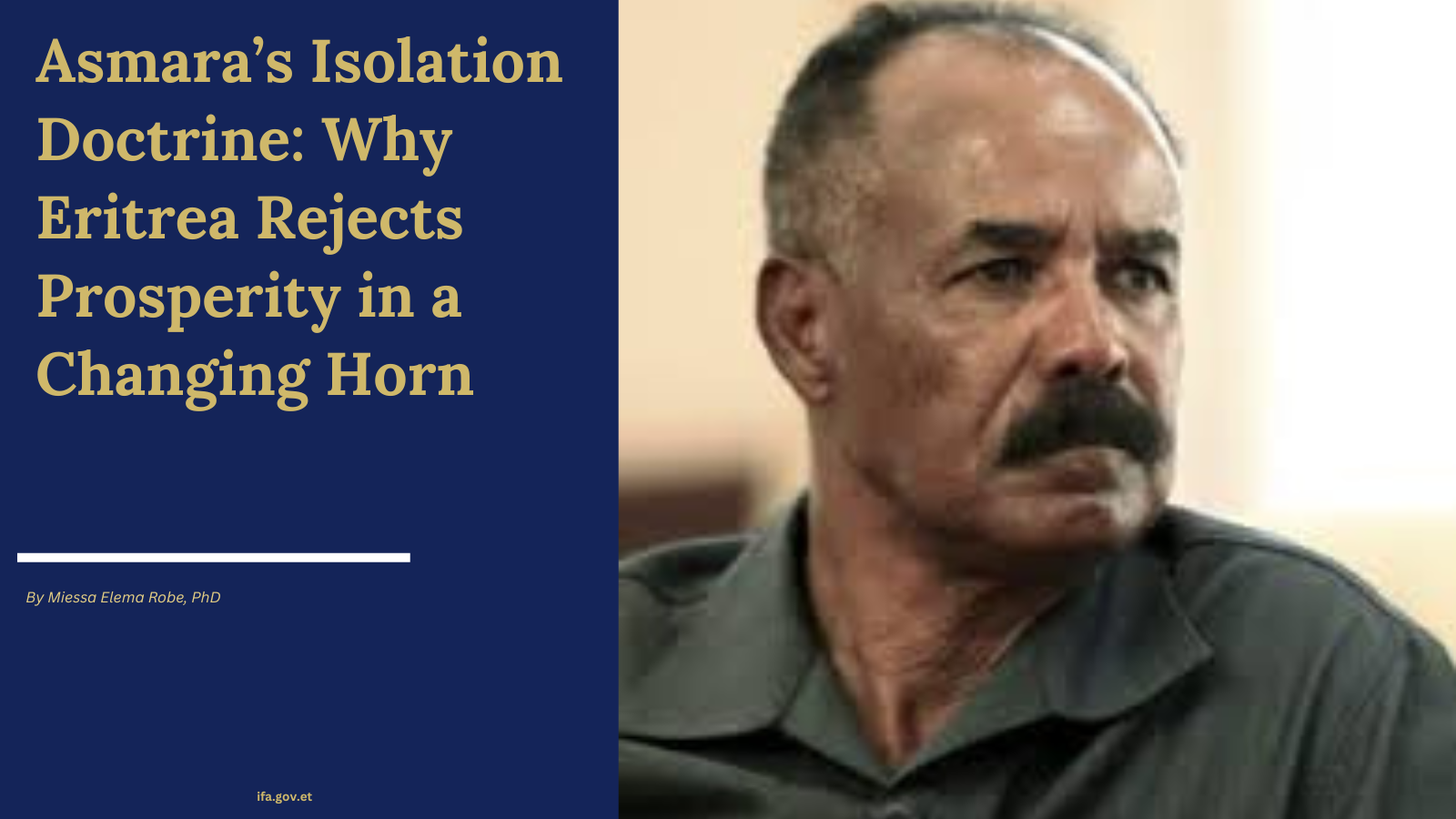
Source: Institute of Foreign Affairs – Ethiopia
The relationship between Ethiopia and Eritrea extends far beyond formal diplomacy. The two nations share intertwined histories, cultures, languages, and social foundations that long predate their modern political separation. Since Eritrea’s 1993 independence, they have remained linked by more than 1,000 kilometers of border and deeply interdependent political and socioeconomic trajectories.
In the decades that followed, relations oscillated between moments of cooperation and phases of tension—from early optimism to devastating war, proxy hostilities, cold peace, and eventual normalization in 2018 after Prime Minister Abiy Ahmed (PhD) came to power. Yet even after peace resumed, Eritrea’s internal political crisis continued to drive hundreds of thousands of Eritreans into Ethiopia, particularly Addis Abeba, seeking safety and dignity. Their migration reflects both the social closeness of the two peoples and the harsh conditions under Eritrea’s authoritarian rule. Few show any desire to return under current circumstances.
Drawing from years of study and close observation, I argue in this article that the blessings and burdens shared by Ethiopia and Eritrea are rooted in a common past, shaped by the present, and decisive for the region’s future. This article examines how Eritrea’s one-man dictatorship has undermined its own national prospects and obstructed peace and stability across the Horn of Africa.
Eritrea After Independence: Promises kept or sacrifices let down?
Thirty and a half years after independence, Eritrea should have been one of Africa’s rising states—blessed with prime geography and a coastline along one of the world’s most strategic waterways. Instead, it remains among the continent’s most closed, militarized, and impoverished nations.
This stagnation is no historical accident. It is a deliberate political choice. President Isaias Afwerki has engineered a system in which prosperity is treated as a threat, regional cooperation as vulnerability, and isolation as a strategy for regime survival. Eritrea’s tragedy is not simply underdevelopment—it is the purposeful construction of poverty, weaponized to preserve undeserved political power.
This brings to my mind a point made by Gedion Thimotewos (PhD), Ethiopia’s Minister of Foreign Affairs, during the Foreign Policy Forum held last month about the Eritrean regime’s miscalculations. He described what he called “Isaias’ doctrine”—the idea that President Isaias takes pride in achieving Eritrea’s political independence while simultaneously believing that Eritrea can rely on Ethiopia for everything it needs for its socioeconomic well-being, even after Eritrea’s secession.
Peace without freedom, stability without growth
Most nations seek peace as a platform for institution-building and economic progress. Isaias’Eritrea seeks peace to immobilize society.
For nearly thirty and a half years, the Eritrean leadership has viewed peace not as a tool for transformation but as a minimal condition: no open conflict and no meaningful socioeconomic change. After three decades, Eritrea still has no implemented constitution, no democratic elections, no independent media, no dynamic private sector capable of innovation, and no open borders that allow the flow of commerce, ideas, or information.
Instead of creating positive peace—peace that expands opportunity and nurtures social well-being—the government offers only the absence of open conflict. It uses this absence of war as justification for the absence of progress.
Poverty as policy, conflict as governance
Where most authoritarian states use economic benefits to secure loyalty, Isaias’Eritrea relies on scarcity to enforce obedience.
The indefinite national service program has immobilized an entire generation, ensuring that poverty remains engineered rather than accidental. Hunger becomes a political tool, and exhaustion becomes a form of control.
The indefinite national service program has immobilized an entire generation, ensuring that poverty remains engineered rather than accidental.”
Externally, the regime sustains and inflates tensions with neighboring states to legitimize permanent militarization. For Asmara, conflict is not a diplomatic failure; it is a governing strategy.
The ruling elite believes that a society trapped in daily survival is easier to dominate than a society empowered by economic opportunity. In Eritrea, this calculation has allowed one-man rule to endure for decades.
While Isaias’Eritrea exports instability across the Horn of Africa, it shows little interest in improving the lives of farmers, workers, or urban residents inside the country.
In effect, the regime competes not with neighboring states but with the well-being and future of its own people, using public policy to deepen poverty so that political control remains unchallenged.
The coastline that was never allowed to prosper
Eritrea possesses one of Africa’s most valuable coastlines. The ports of Massawa and Assab could have evolved into thriving logistics hubs along the Red Sea, integrated with booming Gulf economies and positioned along one of the world’s busiest shipping lanes.
However, the regime views openness as a threat and isolation as a form of security. Prosperity would empower citizens; poverty keeps them dependent and controllable.
While Eritrea closes itself off, landlocked Ethiopia—ambitious and outward-looking—is rapidly expanding its maritime partnerships through Djibouti, Somalia, and Kenya. Ethiopia’s economic growth could have been Eritrea’s greatest opportunity, yet Asmara regards Ethiopia’s dynamism as a threat to its internal political structure.
Five rationales behind Ethiopia’s quest for sea access
Ethiopia’s determination to secure diversified and reliable sea access is often misunderstood. The country’s approach is shaped by historical realities, geographic necessity, international law, developmental logic, and diplomatic principles.
First, Ethiopia’s position is supported by historical precedent: from the Aksumite era until the 1990s, the country maintained access to the Red Sea, and its loss was the outcome of decisions made by unelected guerrilla leaders rather than democratic processes.
Second, Ethiopia’s geography—as the world’s most populous landlocked country with more than 120 million people—makes permanent reliance on a single port corridor unsustainable.
Third, international law, including the United Nations Convention on the Law of the Sea, affirms the rights of landlocked states to secure access to the sea through negotiated agreements, which aligns with Ethiopia’s current approach.
Fourth, Ethiopia argues that maritime cooperation benefits the entire region. Countries such as Eritrea, Djibouti, Somalia, Somaliland, and Kenya can all gain from Ethiopia’s massive market, growing trade volume, and advanced infrastructure. Prime Minister Abiy has repeatedly expressed Ethiopia’s readiness to share the advantages of its major national institutions—such as Ethiopian Airlines, the expanding telecom sector, and even the benefits of the Grand Ethiopian Renaissance Dam (GERD)—as part of mutually beneficial agreements.
Fifth, Ethiopia’s strategy emphasizes peaceful, negotiated solutions. The government insists that any arrangement must be rooted in dialogue, consensus, and broader regional security considerations, recognizing that maritime stability is inseparable from peace in the Horn of Africa.
Together, these five principles form what Ethiopian officials call “the golden pathways to the sea.”
A future bigger than one man’s fear
Eritrea stands at a historic crossroads. It can continue functioning as a hyper-securitized, inward-looking state whose most tragic export is its youth—or it can unlock the prosperity that its geography and people naturally promise.
The world must acknowledge that Eritrea’s stagnation is not an accident. It is a system of institutionalized poverty designed to preserve authoritarian rule.
But no government can permanently suppress the aspirations of its people. Nor can Eritrea isolate itself from the transformations reshaping the Horn of Africa. Ultimately, the country’s future will be determined not by the fears of a single ruler but by the resilience of a population that has endured immense hardship—and still preserved hope.
About the Author: Miessa Elema Robe, PhD, is a political science and international relations analyst specializing in Ethiopia–Eritrea relations. He currently serves as Head of Democratic Culture Building at the Addis Ababa City Administration.
Disclaimer:
The content disseminated by the Institute of Foreign Affairs (IFA) – including, but not limited to, publications, public statements, events, media appearances, and digital communications – reflects the views of individual contributors and does not necessarily represent the official positions or policies of the Institute, its partners, or any affiliated governmental or non-governmental entities.
While the IFA endeavors to ensure the accuracy, integrity, and timeliness of the information presented, it makes no representations or warranties, express or implied, regarding the completeness, reliability, or suitability of such content for any purpose. The Institute expressly disclaims any liability for errors or omissions, as well as for any actions taken or decisions made based on the information provided.
The inclusion of external links, references, or third-party resources does not constitute an endorsement by the Institute. Additionally, engagement on social media platforms – including, but not limited to, likes, shares, retweets (RTs), or reposts – shall not be interpreted as an endorsement or validation of the views expressed therein.Readers and audiences are encouraged to exercise critical judgment and seek independent verification when interpreting or relying upon any information disseminated through publications and posts on the Institute’s platforms or representatives.