Source: rfi
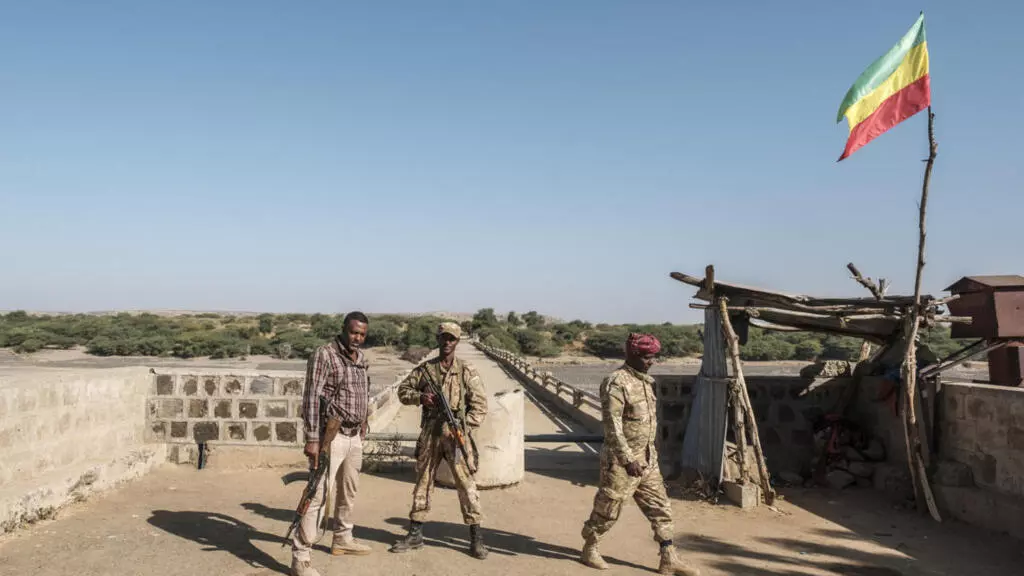
Ethiopia and Eritrea say they are preparing for the possibility of war, with landlocked Ethiopia’s claim it needs access to the Red Sea seen as a provocation by Eritrea. As tensions build, violence is escalating on their shared border in the Tigray region.
In January, Ethiopian police said they had seized thousands of rounds of ammunition sent by Eritrea to rebels in Ethiopia’s Amhara region.
Eritrea denied the allegation, and said Ethiopia was using it to justify starting a war..
The regime “is floating false flags to justify the war that it has been itching to unleash for two long years,” Eritrea’s Information Minister Yemane Gebremeskel told news agencies.
Eritrea’s President Isaias Afwerki said in an interview earlier in February with state-run media that Ethiopia had declared war on his country.
He added that Eritrea did not want war, but knows “how to defend [its] nation”.
Historical feud
Eritrea broke away from Ethiopia in 1993, after a series of insurgencies and wars starting from 1961. The two countries went to war against each other from 1998 to 2000, which was followed by a border conflict that lasted for nearly two decades.
They finally agreed to normalise relations in 2018 – an agreement that won Ethiopian Prime Minister Abiy Ahmed the Nobel Peace Prize the following year.
However, the fragile peace deal has since given way to renewed threats and acrimony.
In Tigray, a region in Ethiopia on the border with Eritrea, a war that erupted in 1975 has been reactivated multiple times – most recently from November 2020 to the end of 2022.
The conflict was reignited in January, as the issues underlying the conflict resurfaced.
“I think one has to start with the Tigray war, with the consequences of the war and the rift that the post-war period and the Pretoria agreement has created between the federal government of Ethiopia and their Eritrean leadership,” an Addis Ababa-based security analyst, who spoke on condition of anonymity, told RFI.
Eritrea has been trying to get closer to the Tigray People’s Liberation Front (TPLF) recently, leading to a feud with Addis Ababa.
“There is information circulating that Eritrean troops have gotten deeper into Tigray, even nearing the capital, Mekelle,” the security analyst said. “They station [themselves] at some of the checkpoints around that area.”
An insurgency movement in the neighbouring Amhara region could be impacted as well by “the security vacuum that has unfolded following the partial withdrawal of security forces and the Ethiopian National Defense Forces from the region,” the analyst said.
Red Sea access
The tensions between Eritrea and Ethiopia have many other unresolved roots. Ethiopia’s anger at Eritrea’s independence stems in part from the fact that this resulted in it losing its access to the Red Sea, as Eritrea sits along the coastline.
“Ethiopia is a much larger country than Eritrea… and Ethiopia has every right to say, listen, we’re going on 120 million people, we need sea access,” Clionadh Raleigh, director of the Armed Conflict Location and Event Data organisation and a professor of African politics and conflict at the UK’s University of Sussex, told RFI.
Eritrea, she said, is less densely populated, and led by an old dictator. “The Isaias Afwerki regime is something that people cannot wait to see end. And Addis is still hoping to reintegrate it into a larger Ethiopia, potentially within the next generation.”
Eritrea regularly accuses the Ethiopian government of threats of military action to regain access to the Red Sea. Abiy has also tried to gain access via a deal with Somaliland, another breakaway region that is destabilising the equilibrium of power within of the Horn of Africa.
But Abiy insists that Ethiopia is not seeking conflict with Eritrea and wants to address the issue of access through dialogue.
The Ethiopian analyst said this is particularly strategically important to the current leadership, which aspires to play a greater regional role and address its geopolitical and strategic vulnerabilities – stemming from lack of access to the Sea.
Wider regional instability
The war in Sudan is also contributing to worsening relations, as Eritrea supports the Sudanese army, along with Egypt and Saudi Arabia, against the paramilitary RSF, which many accuse Ethiopia of supporting.
According to Raleigh, there will be no stability in the Horn of Africa for some time to come.
“Ethiopia is desperate to change, and they do not expect this process to be victimless or peaceful. It has allied itself to both the United Arab Emirates and Israel, against a Saudi-Egyptian-Sudanese coalition, with Somalia somehow,” she said.
As Ethiopia and Eritrea appear to be moving towards conflict, the peace-building agency International Crisis Group has recommended de-escalation steps to avoid direct hostilities – whether these are accidental or, as many fear, the result of Ethiopian aggression.
“Either scenario would be a disaster for the Horn of Africa and its vicinity, potentially drawing in neighbours and non-African powers, particularly from the Arab Gulf,” the group wrote in its latest report.