Author: David Yeo
Source: Facebook
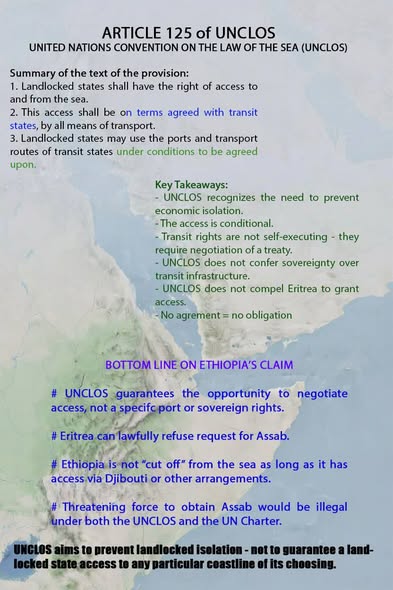
It’s stated clearly and without ambiguity. The issue is squarely within international law rather than political pressure. Under Article 125 of the United Nations Convention on the Law of the Sea (UNCLOS), a landlocked state is not entitled to demand maritime access from a coastal state. It may request transit access, but such access exists only through peaceful agreement. There is no automatic entitlement, no imposed obligation, and no legal authority that compels a sovereign coastal state to provide access to a specific port.
Ethiopia, as a landlocked country, already enjoys maritime access through multiple bilateral arrangements and utilizes numerous ports across neighboring states for trade and commercial purposes. UNCLOS guarantees the possibility of access by agreement; it does not grant the right to select a preferred port, dictate terms, or override another state’s sovereignty. The Convention is explicit that transit rights are exercised on the basis of mutual consent. No consent means no automatic right.
Nothing in Article 125 obliges Eritrea to grant Ethiopia access to Assab, to share sovereignty, or even to enter negotiations if it chooses not to. International law balances the needs of landlocked states with the sovereign equality of coastal states. It does not subordinate one to the other. Eritrea’s territorial integrity and control over its ports, land, and territorial waters remain exclusively under Eritrean authority.
At the same time, Ethiopia retains every option to seek the most favorable commercial arrangements elsewhere. Like any sovereign state engaged in international trade, it may “shop around” for better logistical routes, competitive port fees, or more advantageous transit agreements. That flexibility is part of normal economic diplomacy. But the same market principle applies equally to Eritrea. As a sovereign coastal nation, Eritrea has the full and permanent right to determine the terms under which its ports and services are offered. It may negotiate, set conditions, seek competitive arrangements, or decline entirely. That decision belongs to Eritrea alone.
Eritrea’s land and sea are the natural homeland of the Eritrean people. They are not common property open to external entitlement. Ports, infrastructure, and maritime access represent national assets developed and maintained under Eritrean sovereignty. No state can claim a right to use them without agreement, and certainly not without terms freely accepted by Eritrea. Access to ports is a commercial and sovereign matter not a charitable obligation.
International law is clear: UNCLOS guarantees access through agreement, not access by demand. Sovereignty is not negotiable, not transferable under pressure, and not diluted by external expectation. Ethiopia may pursue its interests through diplomacy and commerce, as all states do. Eritrea, in turn, retains the eternal right to control, protect, and negotiate the use of its land and sea in accordance with its national interest.
In the end, the principle remains firm: mutual consent governs access. Without it, there is no legal claim only sovereign choice.
#followers#insights#highlights#Eritrea#Ethiopia#Eu#UN#AU