Source: Addis Standard
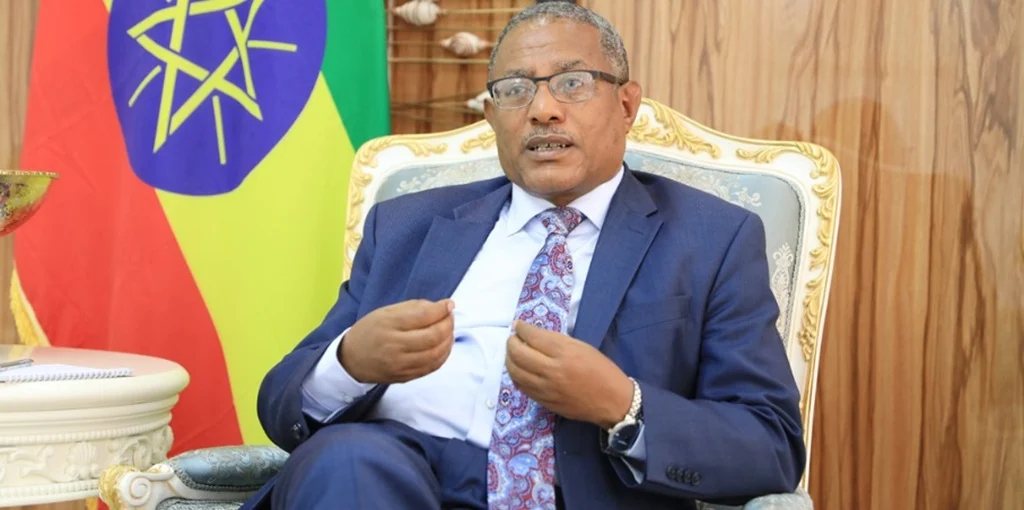
Addis Abeba – Former Minister of Foreign Affairs Gedu Andargachew has disputed Prime Minister Abiy Ahmed’s recent parliamentary account of Ethiopia’s wartime engagement with Eritrea, saying Eritrean forces fought alongside the Ethiopian National Defense Forces (ENDF) “effectively as a single force” until the Pretoria ceasefire halted joint operations.
He said he proposed raising the withdrawal of Eritrean forces from Tigray during the visit but was instructed not to do so. According to Gedu, no message concerning the suffering of civilians in Tigray was delivered in Asmara.
In a letter dated 5 February 2026 and sent to Addis Standard, Gedu rejected Abiy’s claim that he served as the Prime Minister’s envoy to Eritrea after the outbreak of the war in Tigray to convey concerns over crimes committed against civilians. Gedu described the assertion as false and said it misrepresents both his role and the nature of Ethiopia–Eritrea military coordination during the conflict.
According to Gedu, from the beginning of the war in Tigray until the signing of the Pretoria Agreement, Eritrean troops were consistently engaged alongside ENDF units, including during the advance of Tigrayan forces into the Amhara region in mid-2021, when Eritrean forces operated as far as the vicinity of Debre Tabor. He said joint military operations ceased only after the ceasefire was announced.
Gedu added that while Ethiopian and Eritrean forces functioned jointly on the battlefield, distinctions became evident during a lull in fighting following the withdrawal of Tigrayan forces from Amhara, when Ethiopian commanders received senior promotions but Eritrean commanders were excluded.
The former minister said he had initially refrained from commenting publicly on Ethiopia–Eritrea relations due to the sensitivity and “deep bitterness” of the shared history between the two countries. He said he decided to break his silence after the Prime Minister cited his name in a parliamentary address on 3 February 2026 as a witness to explain the causes of tensions between Addis Abeba and Asmara.
Addressing the conduct of the war more broadly, Gedu said the scale of destruction in Tigray had left civilians struggling to survive and warned against attempts to shift responsibility onto a single party. He argued that such an approach undermines accountability and prevents the country from learning lessons necessary to avoid future conflict.
Gedu further accused the Prime Minister of failing to seek reconciliation with the people of Tigray after the war and instead deflecting responsibility for widespread loss of life, destruction of property, and social fragmentation. He linked continuing insecurity in several parts of the country, including Amhara, Oromia, Benishangul-Gumuz, and Gambella, to what he described as weak governance and a reliance on perpetual crisis.
Central to Gedu’s rebuttal is the Prime Minister’s claim that Gedu was serving as foreign minister after the war began and was dispatched to Eritrea with a message urging restraint against civilians. Gedu said he stepped down from his post within days of the war’s outbreak and cannot serve as a witness to support an account that, in his words, contradicts the facts.
Gedu confirmed that he did travel to Eritrea in early January 2021 on the Prime Minister’s instructions but said the mission focused on congratulating President Isaias Afwerki on the joint military campaign against the Tigray People’s Liberation Front (TPLF), thanking Eritrea for its support to ENDF’s Northern Command, and coordinating responses to international allegations of human rights violations.
Addressing lawmakers 3 February 2026, Prime Minister Abiy Ahmed (PhD) told the House of Peoples’ Representatives (HoPR) that the deterioration in relations between Ethiopia and Eritrea began during the early phases of the two-year devastating war in the Tigray region, citing atrocities committed by Eritrean forces, and not Ethiopia’s more recent push for access to the Red Sea.
According to Abiy, the first major rupture occurred after “federal forces captured Shire” in the early phase of the war. “After we cleared Shire in the first round of the war, the Eritrean army followed behind us, entered the town, and began destroying private homes and buildings. That is when the friction started, though we did not speak of it at the time,” he said.
Framing his remarks as a historical record rather than a policy shift, the Prime Minister said he repeatedly sought to stop abuses through peaceful channels. “When the youth were killed in Axum, and when Adwa and Adigrat were being looted, I sent numerous envoys to Eritrea,” he said.
Former foreign minister Gedu Andargachew was dispatched “more than once,” Abiy added, with a clear message: “Do not terrorize the people of Tigray, do not loot their wealth; the fight is with the TPLF, not the people of Tigray.”
When those efforts failed, Abiy said he sent then–Deputy Prime Minister Demeke Mekonnen. Both officials have since left government, but Abiy insisted that “they are still alive; they can be accessed and they can speak to the truth of why they were sent.”
It is recalled that in his remarks to parliament in October 2025, Prime Minister Abiy said that Ethiopia was stripped of sea access without any legal, consultative, or institutional decision. He told MPs that neither the public, parliament, nor the cabinet had sanctioned such a move and that “we cannot find a single document explaining how this happened.” Framing the matter as one of “national existence, a matter of survival,” Abiy stressed that the Red Sea question was neither new nor provocative, and said he had raised it directly with President Isaias Afwerki after the 2018 rapprochement, including in discussions in Asmara and Assab and in his Medemer book sent to the Eritrean leadership.