Source: South China Morning Post
In Ethiopia, Wang joins African Union leader Mahmoud Ali Youssouf in voicing concerns over US raid on Venezuela
China and the African Union issued a joint call to uphold an international law-based order, with particular respect for sovereignty and territorial integrity, in a display of unity against Washington’s raid on Venezuela.
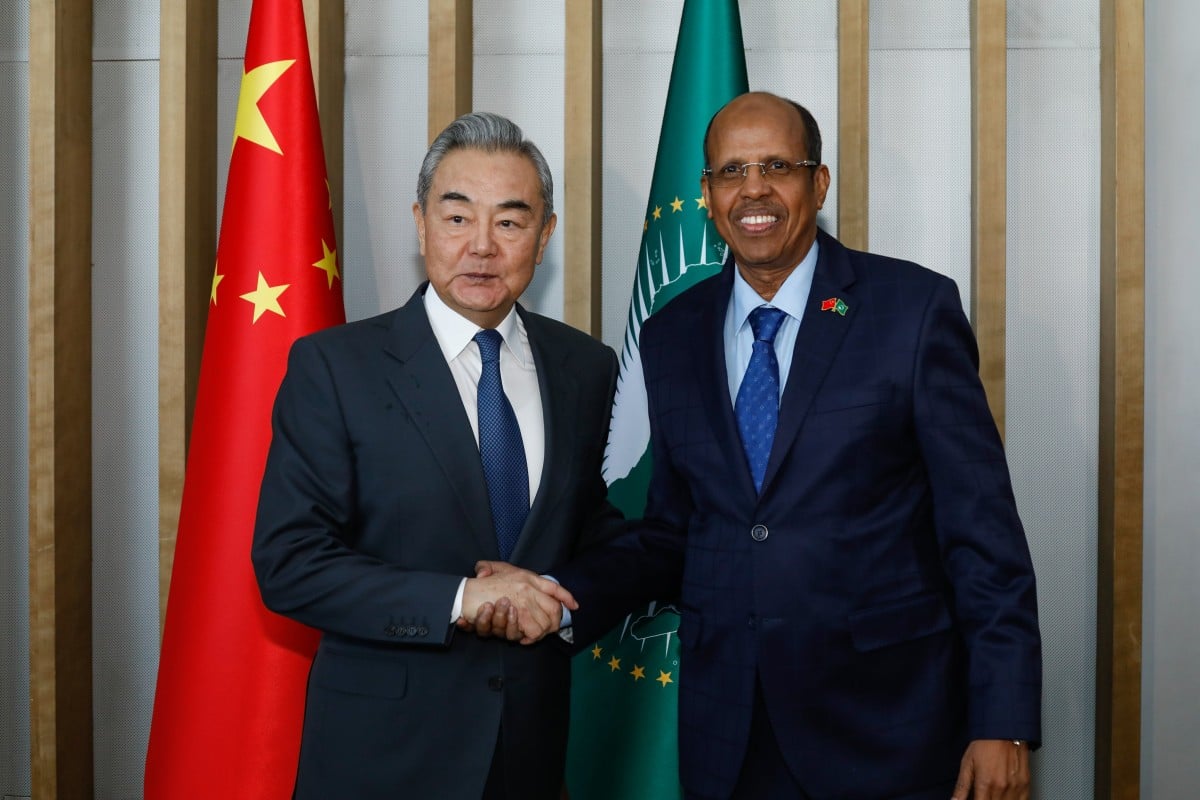
Chinese Foreign Minister Wang Yi and African Union chief Mahmoud Ali Youssouf expressed concerns over the events in Venezuela in a statement released after their meeting in Ethiopia on Thursday.
The United States raided Venezuela on Saturday and abducted its leader Nicolas Maduro and his wife to New York. President Donald Trump also said the US would be in direct control of the country, including its oil.
In the statement, both sides also reaffirmed that “the sovereignty and territorial integrity of all countries must be respected and the fundamental principles of the United Nations Charter and international law must be adhered to”.
As members of the Global South, China and the African Union were committed to supporting each other to safeguard their respective core interests and concerns, as well as further strengthening coordination and cooperation to “inject positive momentum into global and regional peace, stability and development”, it said.
Wang was in Ethiopia, which hosts the African Union headquarters, on the first stop of his tour of the continent, which has been the first overseas destination of the year for Chinese foreign ministers over 36 consecutive years.
Also on Thursday, Wang met Ethiopian Prime Minister Abiy Ahmed at the National Palace in Addis Ababa, telling him that China would continue to promote implementation of its peace and development vision for the Horn of Africa and “play a constructive role in promoting regional peace, stability and mutually beneficial cooperation”.
Beijing, which has been spearheading peace initiatives since 2022, when it appointed a special envoy for the Horn of Africa, uses its “peaceful development model” to resolve conflicts through the integration of megaprojects like ports and railways rather than political interference.
“We are willing to work with Ethiopia to implement the consensus … firmly support each other, strengthen the alignment of development strategies, deepen exchanges of experience in governance and continuously elevate the all-weather strategic partnership between China and Ethiopia to new heights,” Wang said, according to a Chinese foreign ministry statement.
Abiy noted that they had discussed development cooperation and regional issues. “We also discussed deepening cooperation in the economy, trade, infrastructure, energy and transport, as well as tapping the potential for collaboration in emerging areas such as e-commerce, the digital economy, artificial intelligence and green energy,” he said.
Zhou Yuyuan, deputy director of the Institute for Foreign Policy Studies and director of the Centre for West Asian and African Studies at the Shanghai Institutes for International Studies, said the Horn of Africa was central to Chinese diplomacy and the Belt and Road Initiative.
According to Zhou, peace, stability and development in the Horn of Africa aligned with Beijing’s strategic and economic interests. “China has been conducting shuttle diplomacy in the region through the [foreign ministry’s] special envoy for Horn of Africa affairs,” he added.
On his tour of Africa, which runs until January 12, Wang will stop in Somalia on the first visit by a Chinese foreign minister since the 1980s.
The trip comes a month after Israel became the first country to recognise Somaliland, which declared independence from Somalia in 1991 amid the collapse of central government authority.
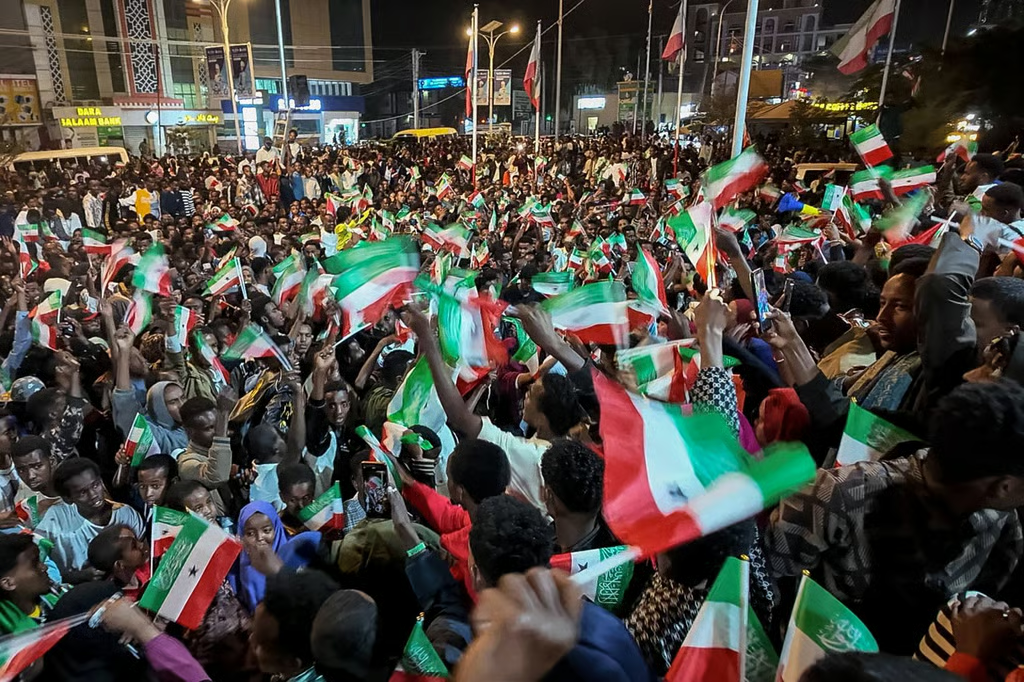
Israeli Foreign Minister Gideon Saar visited Somaliland on Tuesday to formalise plans to set up embassies and institutionalise diplomatic ties.
Beijing protested against the recognition, saying that it “firmly opposes any move that undermines Somalia’s sovereignty”.
Former US ambassador to Ethiopia David Shinn, a professor at George Washington University’s Elliott School of International Affairs, said Wang was likely to repeat the condemnation and stress Beijing’s support for Somalia’s sovereignty and territorial integrity.
“This plays well with China’s position on Taiwan and permits him to take another swipe at Taipei, which has established a liaison office in Somaliland’s capital,” Shinn said.
Beijing views Taiwan as a part of China and has never renounced the use of force to reunify it with the mainland. Most countries, including Somalia, do not recognise Taiwan as an independent state.
Shinn said Wang might use the visit “to encourage Ethiopia to seek only peaceful access to the Red Sea and to maintain cordial relations with Somalia”.
Landlocked Ethiopia signed a memorandum of understanding with Somaliland in 2024 to gain access to the Red Sea for a naval base and commercial port. Ethiopia says its quest for sea access is an existential necessity but Somalia has called it an act of aggression.
Relations between the two countries have thawed in recent months, but the memorandum remains an obstacle to resolving the tension.
According to Shinn, Wang “may also juxtapose” Trump’s recent criticisms of Somali immigrants to the US with “praise for the Somali people”.
Last month, Trump said Somalis “contribute nothing” to the United States and terminated their temporary protected status, which is granted to citizens of selected countries where there is conflict or a humanitarian crisis.
Trump has previously accused Minnesota’s Somali community of being a “hub of fraudulent money laundering”.
Wang will also visit Tanzania and Lesotho. The former is one of China’s strongest African partners while small, landlocked Lesotho in southern Africa is among the countries that were hardest hit by Trump’s tariffs.
China has much at stake in Tanzania, where it has promised to upgrade the 50-year-old Tanzania-Zambia railway, a key logistical route that allows access to the vast copper deposits of Zambia and the Democratic Republic of Congo (DRC).
The line is seen as a strategic counterweight to the US-backed Lobito Corridor, which connects Zambia to the Atlantic via Angola and the DRC.
In Lesotho, Wang is expected to focus on China’s zero-tariff treatment for exports, in contrast to Washington’s recent termination of the African Growth and Opportunity Act, which Shinn said had greatly benefited the country’s exports to the US.