Source: Brokena
By: Merhatsidk Mekonnen Abayneh
Once our 14th province following the unwarranted abrogation in 1962 of its autonomy as a federated state and subsequent incorporation into the defunct Ethiopian Empire, Eritrea becomes a sovereign entity in the strict sense of the term whose international relations should be normally governed by the relevant provisions of international laws and protocols including the UN Charter. The country has managed to separate itself from Ethiopia and establish its own distinct state after the prolonged war of liberation for three consecutive decades.
Quite astonishing to recall, Eritrea might be the only state on earth who has been allowed by the leader of the mainland nation to comfortably walk free out of its formal political bondage and establish its own sovereign statehood through an official letter of recognition boldly and uncompromisingly written to the UN not known to customary international law and practice ever before.
Let us not forget here that, it was not actually the victorious Eritrean People’s Liberation Front, (EPLF) in general, and Isaias Afeworki in particular, that has wickedly and irresponsibly deprived Ethiopia access to the Red Sea at the time of cessation.
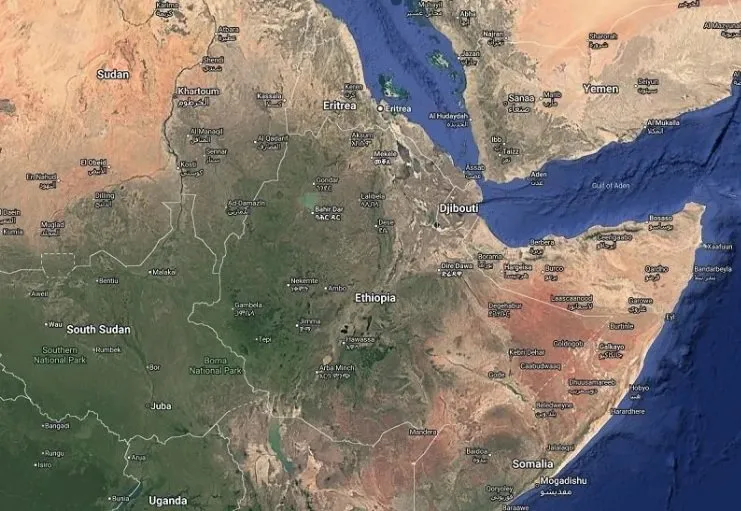
Paradoxically, though, it was Meles Zenawi, the then emotionally intoxicated chief of the Tigrean People’s Liberation Front, (TPLF) and later self-appointed President of the Transitional Government of Ethiopia that had condemned the country to be robbed of its twin ports of Massawa and Asab only to remain landlocked indefinitely having been preoccupied more for the Eritrean than Ethiopian cause.
Shame on him; Meles perpetrated this generational crime regardless of serious and pragmatic call for reconsideration and possible compromise arrangements that could have at least spared the port of Asab closest to the hinterland to stay with mainland Ethiopia in favor of sustainable peace and harmonious relationship between the two countries in the future. Yet, he did not hesitate to reject right away even the sensible proposal put forward on the part of the foreign mediators available in the London Conference like Hermann Cohen, who was by then the U.S Assistant Secretary of State for African Affairs.
This contributor is very well aware of the fact that there are few prominent figures from among the outgoing U.S State Department circles such as Susan rice who happened to openly and squarely admire and unnecessarily glorify X-Prime Minister Meles as the ‘world-class leader’ and ‘bright-minded personality’ for their own sake .
As far as I am concerned, however, due to his unusual betrayal of national interest and anti-Ethiopian stance, Zenawi must, in this case, be remembered as the first ever crooked statesman whose very name has been enlisted by historical records in an ugly color for having denied a tiny corridor of passage into the Red Sea for the very country he had prepared himself to govern in an authoritarian rule by saying no to the proposed compromise arrangement at the time in view of mutual interests.
Since then, Ethiopia has been experiencing far too many painful and backbreaking repercussions brought about by the status of landlockedness superimposed on the nation primarily by its own leader infamous for his indifference that goes down in history.
According to Wikipedia, “a landlocked country is a country that has no territory connected to an ocean” or whose entire coastline falls within the limit of its dryland borders.
Currently, there are 44 landlocked countries throughout the planet, 32 of which are Developing ones. Whereas faraway Kazakhstan is the largest of all of them in size, our own Ethiopia becomes the world’s most populous landlocked country on earth.
Irrespective of its causation, the undesired status of landlockedness in terms of physical geography which a given nation finds itself in, no doubt, creates an array of profound political and economic disadvantages that having access to international waters would simply avoid to the contrary. Consequently, nations, large and small alike, have fought against one another to gain access to open waterways throughout history even at the heavy expense in terms of human and material resources.
Being cognizant and conscious of this inequity prevailing in the uneven distribution of territorial and oceanic resources, therefore, the global community has negotiated for long and managed to reach a universally acceptable treaty on how to approach and resolve this conundrum in an inclusive and balanced way. To that effect, PART X of the 1982 UN Convention on the Law of the Sea running from Art. 124 through Art. 132 has been devoted to address the Right of Access of Landlocked States to and from the Sea and the Freedom of Transit in a rather precautionary formulation.
Hence, the core issue that needs to be examined on this regard is whether or not Eritrea can be justified to prevent Ethiopia from using the former’s newly acquired territory as a passage to the edge of the Red Sea in the name of sovereign jurisdiction pursuant to the relevant provisions of the said multi-lateral convention.
Prior to the detailed regulation of their relations and interactions with one another in subsequent provisions, the convention under Art. 124 Sub-Art. (1) (a) and (b) has preferred to define such key notions as the “Landlocked States” and “Transit States” respectively
Accordingly, “Landlocked State” refers to a State which has no sea-coast whereas “transit State” stands for a State with or without a sea-coast situated between a land-locked State and the sea, through whose territory traffic in transit passes. In this context, mainland Ethiopia becomes a landlocked state whereas the newly born Eritrea assumes the status of a transit state with its 1350 k.ms long coastline, obviously to the glaring disadvantage of the former.
The governing rule is that “Landlocked States shall have the right of access to and from the sea for the purpose of exercising the rights provided for therein, including those relating to the freedom of the high seas and the common heritage of mankind”, as laid down and elaborated in Art. 125 Sub-Art. (1) of the UN convention on the Law of the Sea instrumentalized to regulate the right of access to and from the sea along with the freedom of transit.
What it simply means is that landlocked States like Ethiopia are entitled to enjoy freedom of transit through the territory of transit States using all means of transport without any hurdle. Sub-Art. (2) of the above-cited Art. 125 makes it further clear and explicit that the terms and modalities for exercising the freedom of transit are to be agreed upon by and between the contracting parties concerned using the instrumentality of bilateral, sub-regional or regional agreements as they wish.
Conversely, the reciprocal right of the transit states such as Eritrea , in this case, is to take all the necessary measures with a view to ensuring that the landlocked states may, in no case, infringe upon their legitimate interests inherently attached to their sovereign authority while exercising the rights, freedoms and facilities provided them as equally legislated under Sub-Art. (3) of the same Article.
Are we not thus persuaded enough to be convinced that the State of Eritrea is not justified under international law to deny Ethiopia an outlet to the sea?
On the other hand, present-day Ethiopia is not entitled to reoccupy and rule that country like in the past and it should not claim to do so in an attempt to get rid of the misfortune and thereby alleviate the multiple pressures associated with its own landlockedness. Hence, the recent war of words between the two countries must cool down and, in no time, be transformed into mutually beneficial negotiation and third party assisted mediation to settle the ongoing dispute by peaceful means before it escalates into another round of catastrophic conflict.
The facilitative support and role of such continental and global bodies and friendly nations as the African Union Commission, the European Union, the United Nations and the United States is of paramount importance in this regard.
Admittedly, Eritrea is, once again, a sovereign nation recognized by the international community with a full-fledged authority competent enough to manage its own domestic and external affairs without foreign domination.
Nevertheless, there is, as has been indicated earlier, no such thing as absolute and rigidly comprehended notion of state sovereignty as that of the rudimentary construction of the 1648 Westphalian one in contemporary international law.
Potential or real, the present Eritrean state thus assumes the liberalized status of sovereignty akin to modern states with its qualified privileges and comparable responsibilities, so to speak. The growing volume of international law including the UN Convention on the Law of the Sea constrains on and has gradually relaxed the rigidity of traditionally exclusive concept as has been long applied in the past.
Disappointingly enough, though, one cannot be pretty sure that the uncompromising regime in Asmara is willing and shall be ready to pursue this diplomatic course of action as compared with its Ethiopian counterpart under the circumstances.