Source: C4ADS
Data Centers, Global Technology, and China’s Surveillance Infrastructure in the Uyghur Region
The Bottom Line Up Front
Data centers are an essential component of China’s expansive mass surveillance system in the Uyghur region, quietly processing biometric and behavioral data to target ethnic minorities — yet they remain the least scrutinized component of this digital architecture, even as compatibility with American technology continues to be required.
Executive Summary
The People’s Republic of China (PRC) operates one of the most expansive mass surveillance systems in the world, and data centers are its foundation. These facilities provide the physical infrastructure that stores, processes, and acts on the biometric data, communications records, and behavioral patterns used to monitor citizens, especially ethnic minorities. Despite significant international attention to forced labor, atrocity crimes, and surveillance in the Uyghur region, the digital backbone enabling those abuses has received comparatively little scrutiny.
Beijing’s “Eastern Data, Western Computing” initiative has accelerated this buildout, and the Chinese Communist Party (CCP) has designated the region a “crucial component” of the Belt and Road Spatial Information Corridor, with plans to use the data centers in the Uyghur region to extend Chinese data infrastructure into Central Asia. The region simultaneously functions as a testing ground for digital authoritarianism: government records reveal comprehensive digitization of medical, educational, judicial, and administrative systems, with surveillance triggers that include indications of ethnic identity. Individuals identified as high risk can face interrogation, coercive labor, or detention.
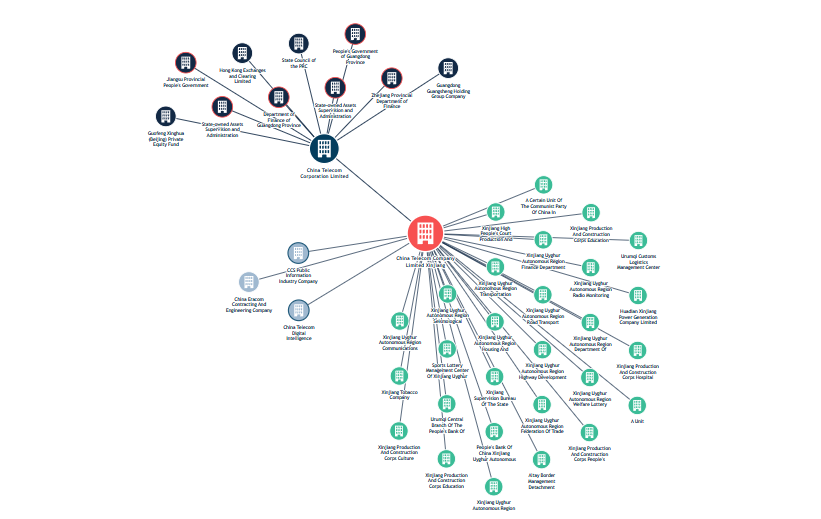
Two case studies illustrate the global dimensions of this infrastructure. The first examines the Yanqi Vocational Technical School, operated by the Xinjiang Production and Construction Corps (XPCC), a sanctioned paramilitary organization. A 2024 government contract reveals that U.S. technology – including processors, graphics cards, and facial recognition hardware – tracks students’ movements, meals, and curfew compliance in real time. Vocational schools in the Uyghur region have drawn criticism as sites of indoctrination, forced assimilation, and detention. The required semiconductors (“chips”) specified in these documents fall below the threshold for export-controlled AI chips, revealing a critical gap: current controls do not adequately address the PRC’s surveillance technology pipeline. The second case study examines China Telecom Xinjiang, a subsidiary of a U.S.-sanctioned state-owned enterprise that operates at least four data centers in the region. The subsidiary holds active contracts with the XPCC and provides services to entities designated as military or intelligence agencies – activity its parent company’s OFAC listing has not prevented. Meanwhile, China Telecom, the sanctioned parent company, claims to still operate data centers in the United States.
C4ADS’ analysis of 2024-2025 Xinjiang Uyghur Autonomous Region (XUAR) government documents found references to American and Taiwanese technology across data center projects in the region. Whether above or below export control thresholds, American and Taiwanese technology continues to flow into surveillance infrastructure targeting a population subject to documented atrocity crimes. Meaningful change will require action beyond the corporate level. C4ADS recommends adding China Telecom and its provincial subsidiaries to the Commerce Department’s Entity List and mandating post-shipment verification for dual-use technology exports destined for regions with documented records of atrocity crimes – with clearer liability standards for exporters whose hardware reaches military or intelligence-affiliated end users.
China Telecom Xinjiang’s Ownership Structure and Domestic Supply Chains