Source: Addis Standard
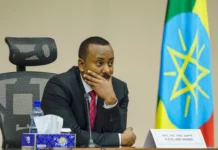
Addis Abeba- Eritrean President Isaias Afwerki used his keynote address marking Eritrea’s 35th Independence Day to sharply question the global policies of U.S. President Donald Trump, despite recent reports that Washington is considering sanctions relief and a diplomatic reset with Asmara.
Speaking in Asmara on Saturday, Isaias said the policies pursued under Trump’s “Make America Great Again” (MAGA) doctrine required “serious and careful assessment,” describing the phenomenon as “highly complex and heavy” and warning against “premature conclusions.”
“In view of the palpable global stature of the United States, I had highlighted… the prudence of undertaking serious and careful assessment of the policies and potential ramifications of the Trump Administration upon its return to the White House,” Isaias said.
The Eritrean leader devoted a significant portion of his speech to criticizing what he described as decades of reckless U.S. global dominance, arguing that Washington’s economic model, military interventions, and geopolitical conduct had produced global instability and unsustainable debt.
Isaias said successive U.S. administrations had accumulated “alarming” levels of debt through “prolonged fiscal wastefulness,” claiming America’s national debt had risen from over $30 trillion last year to nearly $40 trillion. He also criticized the “offshoring” of industries, which he said was designed to entrench U.S. economic hegemony by exploiting cheap labor and resources abroad.
While acknowledging that Trump appeared aware of what he described as America’s “trajectory and prospects of decline,” Isaias questioned whether policies such as tariffs, industrial repatriation, tax cuts, monopolization of rare minerals, and “threats and intimidation” could reverse the situation.
“Where, and with whom can these policies possibly succeed?” he asked.
Isaias also challenged Washington’s claims to military and technological superiority, saying there were “no indicators” proving U.S. dominance in areas such as artificial intelligence, while warning against measuring military strength solely through “intimidation, targeted killings,” and advanced weapons systems.
The Eritrean president further criticized what he called unilateral U.S. actions against countries including Iran and Venezuela. On Iran, he questioned the legal and moral basis for U.S. military action and sanctions tied to Tehran’s nuclear program.
“Why is Iran alone prohibited?” he asked. “What legal privilege has the United States to take unilateral military action?”
Referring to escalating tensions surrounding the Strait of Hormuz, Isaias warned that the situation was driven by “grave miscalculation” and called for efforts to avert wider regional and global instability.
The remarks came amid reports of a possible thaw in relations between Eritrea and the United States. Earlier this month, The Wall Street Journal, reported that the Trump administration was weighing sanctions relief and broader diplomatic engagement with Eritrea as part of growing U.S. strategic interest in Red Sea security.
According to the report, Washington views Eritrea’s Red Sea coastline as increasingly important amid regional instability and threats to maritime trade routes. The discussions reportedly involved Trump’s senior adviser for Africa, Massad Boulos, alongside Eritrean and Egyptian officials.
Despite the reported outreach, Isaias maintained his longstanding criticism of the prevailing international order, arguing that the current global system — which he described as exploitative and rooted in “zero-sum paradigms” — had become unsustainable.
“Transitioning from the old and exhausted global order… is no longer optional,” he said, calling for a new international system based on “fairness and justice.”
Notably, despite extensive remarks on U.S. global policy and Washington’s role in international affairs, Isaias made no reference in his speech to the reported possibility of sanctions relief or renewed diplomatic engagement with the United States. The omission comes amid growing speculation over whether Asmara is prepared to reciprocate the diplomatic overtures reportedly being explored by the Trump administration.
In a statement released on 24 May, U.S. Secretary of State Marco Rubio extended congratulations to the Eritrean people and said the United States “recognizes the importance of peace, security, and economic development in the Horn of Africa.”
The statement further said Washington looked forward to “continued dialogue” with Eritrea on regional stability and mutual interests, amid broader discussions reportedly taking place over possible sanctions relief and normalization of ties.
The conciliatory tone of the State Department message contrasted with Isaias’ speech, in which he sharply criticized decades of U.S. global dominance, questioned Washington’s military and economic policies, and accused powerful states of perpetuating an unjust international order. At the same time, Isaias avoided directly addressing the recent U.S. diplomatic overtures or the possibility of sanctions relief.
Isaias devoted small part of his speech to regional issues in the Horn of Africa, describing the situations in Somalia, Ethiopia, Sudan, and South Sudan as “deeply precarious” and requiring urgent attention.
Reflecting on Eritrea’s past efforts to transform the Intergovernmental Authority on Development (IGAD) from a bloc focused on drought and desertification into a broader regional framework for development and cooperation, Isaias said those ambitions “did not come to fruition.”
He argued that the region’s core crises stem from failed nation-building processes, accusing countries in the Horn of becoming polarized along “ethnic, clan, and religious lines,” while also criticizing what he described as the rise of warlords, entrenched corruption, and foreign interference.
“Instead of building citizen-cantered nationhood, societies are polarized along vertical ethnic, clan, and religious lines, thereby stoking hatred and civil strife,” he said.
Isaias further described foreign intervention and “subservience to external interests” as the region’s “most detrimental” problem, calling for the “immediate termination of external interventions and funding” as a prerequisite for stability in the Horn of Africa. AS