Source: Ethiopian Institute of Foreign Affairs
Reframing “Assab Yemanat?”
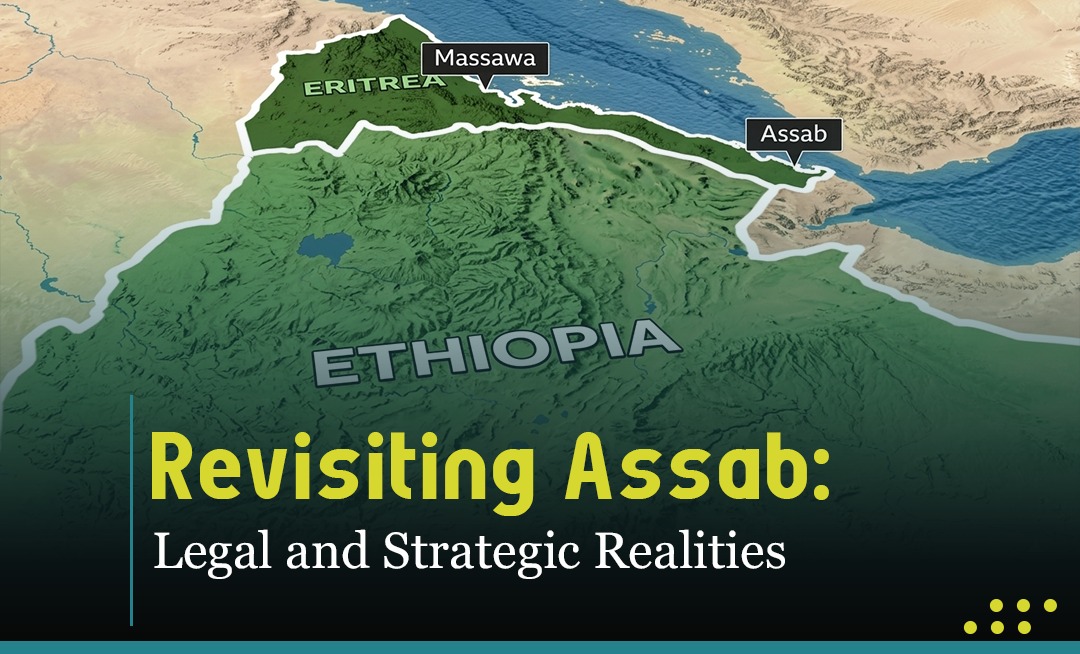
The enduring question encapsulated in the Amharic phrase “Assab Yemanat?” (“Whose is Assab?”) is not merely a matter of historical curiosity; it is a complex legal, geopolitical, and developmental issue that continues to shape Ethiopia’s strategic outlook. While much of the existing literature has treated the matter descriptively, cataloguing competing claims and historical developments—this article departs from a purely historical framing and instead advances the argument that the issue must be understood through the lens of contemporary international law, geopolitical realities, and the structural imperatives of economic development.
At its core, the question is not simply one of retrospective sovereignty, but of whether existing legal frameworks, treaty obligations, and principles governing access to the sea provide a basis for Ethiopia to assert a legitimate claim to maritime access and, potentially, to a more defined sovereign or quasi-sovereign arrangement. By shifting the focus from historical ownership to legal entitlement and strategic necessity, this analysis seeks to reframe the debate around Assab as a question of rights, obligations, and regional stability in the modern international system.
Historical Legal Agreements
A legal assessment of Assab must be grounded in the treaties and agreements that shaped Ethiopia–Italy relations, rather than on historical narrative alone. The port’s initial acquisition by the Italian Rubattino Shipping Company in 1869–1870 was a private transaction with local authorities, not a formal cession by the Ethiopian state, leaving its original legal basis open to question, (Yacob Haile-Mariam, 2011). Subsequent treaties of 1900, 1902, and 1908, while addressing boundary delimitation, failed to clearly determine the status of Assab, with the 1908 agreement in particular lacking precision regarding the southern limits of the coast (Negash, Eritrea and Ethiopia: The Federal Experience, 1997). These ambiguities are compounded by arguments that treaties were concluded under unequal conditions and by Italy’s 1935 invasion, widely regarded as a material breach, followed by renunciation of colonial claims in the 1947 Peace Treaty. Moreover, UN General Assembly Resolution 390 (A) (1950), while not resolving sovereignty, recognized Ethiopia’s need for maritime access, situating the issue within a broader international legal framework. Taken together, these instruments reveal an ambiguous legal record that sustains competing interpretations and reinforces the centrality of legal entitlement over historical ownership.
International Law and Contemporary Principles
The ambiguity of historical agreements shifts the analysis to contemporary international legal norms. Under the United Nations Convention on the Law of the Sea (UNCLOS, 1982), landlocked states are entitled to access the sea and freedom of transit through neighboring territories under agreed terms, a principle supported by the International Court of Justice in Pulau Ligitan and Pulau Sipadan (Indonesia/Malaysia, 2002, paras. 128–35). While UNCLOS does not confer sovereignty over coastal areas, it recognizes access as a legal and economic necessity. This principle has been reinforced in international jurisprudence, notably in the ICJ case Obligation to Negotiate Access to the Pacific Ocean (Bolivia v. Chile, 2018), where the Court acknowledged the centrality of access to the sea for landlocked states. Taken together, these developments underscore that although historical treaties may not conclusively establish sovereignty over Assab, contemporary law supports the argument that Ethiopia’s claim to maritime access carries legal weight within a framework of equity, development, and regional stability.
Comparative African Context
This legal framework gains further weight in the African context, where landlocked states routinely negotiate port access as a matter of necessity and practice. Ethiopia, Uganda, Rwanda, South Sudan, Mali, and Niger all rely on port access through neighboring countries, often formalized via transit agreements, infrastructure projects, and legal entitlement. Ethiopia’s dependence on Djibouti, Uganda and Rwanda’s use of Kenyan and Tanzanian ports, and Mali and Niger’s access via Senegal, Côte d’Ivoire, and Benin illustrate a continental norm in which maritime access is negotiated within legal and economic frameworks rather than secured solely through sovereignty (African Union, Agreement Establishing the African Continental Free Trade Area, 2018; United Nations, Convention on Transit Trade of Landlocked States, 1965; Vaughn, Ethiopia’s New Infrastructure Diplomacy, 2019). Regional instruments, including the AfCFTA, emphasize facilitation of trade and equitable access for landlocked nations.
Moreover, African Union principles and regional customs increasingly support solutions that prioritize stability, economic development, and shared benefit. Ports are frequently treated as strategic infrastructure rather than exclusive national assets, enabling landlocked states to exercise practical authority over usage, logistics, and administration through bilateral or multilateral agreements (Erlich, The Struggle over Eritrea, 1983; Negash, Eritrea and Ethiopia: The Federal Experience, 1997). This normative framework reinforces Ethiopia’s position: while formal sovereignty over Assab may be contested, historical integration, infrastructure investment, and sustained economic reliance create a precedent consistent with both regional practice and international law. In essence, African examples demonstrate that maritime access disputes are routinely resolved through negotiated cooperation, joint administration, and long-term access arrangements, rather than by asserting exclusive territorial control—a pattern directly applicable to Ethiopia’s claims over Assab.
Ethiopian Investment
Historical evidence indicates that Ethiopia played a central role in developing Assab into a functional port. The Ethiopian state invested heavily in infrastructure—including roads, port facilities, administrative offices, and social services such as schools and hospitals—effectively integrating Assab into the national economy (Yacob Haile-Mariam, 2011; Tekeste Negash, 1997). By the time of Eritrean independence, Assab had become a major commercial hub, serving as a critical outlet for imports and exports and operating effectively as an extension of Ethiopia’s domestic economic space. These sustained investments demonstrate effectivités, the practical exercise of authority recognized in international law as evidence of control and influence over a territory, particularly when formal sovereignty is ambiguous (ICJ, Pulau Ligitan and Pulau Sipadan, 2002, paras. 128–35; ICJ, Frontier Dispute (Burkina Faso v. Mali), 1986, paras. 63–65; Malcolm N. Shaw, 2017). ICJ jurisprudence indicates that effective control strengthens claims when it is continuous, public, and carried out by recognized state organs, although it rarely overrides clear legal title (Tekeste Negash, 1997; Patrick Dumberry, 2007). In Assab’s case, Ethiopia’s long-term administration and development of the port satisfy these criteria to a significant extent, reinforcing a claim to functional and economic authority, even if formal sovereignty remains contested. From a policy perspective, this historical role provides a legally and politically relevant foundation for contemporary claims to maritime access and supports the argument for negotiated arrangements, such as preferential access, joint administration, or long-term leasing, rather than a purely adversarial approach based on sovereignty alone (Tekeste Negash, 1997; Haggai Erlich, 1983).
Taken together, the historical ambiguities surrounding Assab, the evolution of international legal principles, and African state practice point toward a clear conclusion: the issue is no longer a question of exclusive historical sovereignty, but of how maritime access can be secured within a legitimate and sustainable legal framework. Ethiopia’s position aligns with a broader normative and practical shift in international relations that prioritizes economic viability, regional integration, and cooperative sovereignty (African Union, 2018; United Nations, 1965). Rather than framing the issue as a zero-sum contest, the most viable path lies in negotiated arrangements—through long-term leases, joint administration, or enhanced transit agreements—that balance the rights of coastal states with the developmental imperatives of landlocked nations. This approach reflects prevailing international practice and offers a foundation for stability and mutual benefit in the Horn of Africa (Vaughn, 2019; Kidane Mengisteab, 2014)
Reference
- Yacob Haile-Mariam, Asseb Yemane Nat? (“Whose is Assab?”) (Addis Ababa, 2011).
- Tekeste Negash, Eritrea and Ethiopia: The Federal Experience (Uppsala: Nordic Africa Institute, 1997).
- Haggai Erlich, The Struggle over Eritrea, 1962–1978: War and Revolution in the Horn of Africa (Stanford: Hoover Institution Press, 1983).
- Treaty of Peace with Italy, 1947, Article 23; Vienna Convention on the Law of Treaties, 1969, Articles 51–52.
- UN General Assembly Resolution 390 (A) (V), “Eritrea: Federal Federation with Ethiopia,” 2 December 1950.
- United Nations Convention on the Law of the Sea (UNCLOS), 1982, Articles 125–132.
- International Court of Justice, Obligation to Negotiate Access to the Pacific Ocean (Bolivia v. Chile), Judgment, 1 October 2018.
- African Union Agreement Establishing the African Continental Free Trade Area (AfCFTA), 2018; United Nations, Convention on Transit Trade of Land-Locked States, 1965.
- Ibid.
- Yacob Haile-Mariam, 2011; Tekeste Negash, 1997.
- ICJ, Pulau Ligitan and Pulau Sipadan (Indonesia/Malaysia), 17 December 2002, para. 134; ICJ, Frontier Dispute (Burkina Faso v. Mali), 22 December 1986, para. 63.
- Malcolm N. Shaw, International Law, 8th ed. (Cambridge: Cambridge University Press, 2017), 365–370.
- Vienna Convention on Succession of States in Respect of State Property, Archives and Debts, 1983.
- Patrick Dumberry, State Succession to International Responsibility (Leiden: Martinus Nijhoff, 2007).
By Kuchim Sileshi, IFA
Disclaimer:
The content disseminated by the Institute of Foreign Affairs (IFA) – including, but not limited to, publications, public statements, events, media appearances, and digital communications – reflects the views of individual contributors and does not necessarily represent the official positions or policies of the Institute, its partners, or any affiliated governmental or non-governmental entities.
While the IFA endeavors to ensure the accuracy, integrity, and timeliness of the information presented, it makes no representations or warranties, express or implied, regarding the completeness, reliability, or suitability of such content for any purpose. The Institute expressly disclaims any liability for errors or omissions, as well as for any actions taken or decisions made based on the information provided.
The inclusion of external links, references, or third-party resources does not constitute an endorsement by the Institute. Additionally, engagement on social media platforms – including, but not limited to, likes, shares, retweets (RTs), or reposts – shall not be interpreted as an endorsement or validation of the views expressed therein.
Readers and audiences are encouraged to exercise critical judgment and seek independent verification when interpreting or relying upon any information disseminated through publications and posts on the Institute’s platforms or representatives.