Souce: Edelstam Foundation
OP-ED Article published in Swedish magazine Journalisten, 10 December 2025.
The release last week of thirteen political prisoners in Eritrea, who have been detained for 18 years with no contact to the outside world, is an unequivocal sign that the pressure on the Eritrean regime is rising. At the same time, Swedish officials have refused to publicly comment on Dawit Isaak’s case for 24 years, despite the fact that he remains imprisoned in Eritrea. Swedish diplomats claim that they lack effective means of pressuring the Eritrean regime. “There is nothing Eritrea wants,” is the common argument. In fact, there are many things that the Afwerki regime very much likes to have, write SUSANNE BERGER and CAROLINE EDELSTAM.
Pressed by the family of Swedish Eritrean journalist Dawit Isaak, who has been arbitrarily imprisoned in Eritrea for 24 years, Sweden’s Foreign Minister Maria Malmer Stenergard made a public statement on September 25, 2025 in which she demanded Isaak’s release on humanitarian grounds and his return home to Sweden. The statement, which came immediately after a meeting with her Eritrean counterpart Osman Saleh in New York, was one of the strongest requests the minister has made in years.
The very public step strongly suggests that Swedish authorities know – or assume – that Dawit Isaak is alive. But more than two months later, there are no signs that Eritrea is willing to meet Swedish demands, or that Sweden and the EU are in any way ready to directly challenge Eritrea to put an end to Dawit Isaak’s ordeal.
In the meantime, Swedish officials have not managed to obtain even the most basic sign of life from him. This stalemate has lasted now since at least 2014, which raises many important questions. None of it seems normal. One begins to wonder if Swedish officials actually believe Eritrea’s claims that their citizen is alive and relatively well. If so, why does the Swedish government not make a much more determined effort to secure his release?
Now is the time for more forceful and decisive action. There are unequivocal signs that the regime is under pressure, as illustrated by the sudden release of a group of prisoners who were imprisoned for 18 years. They were reportedly arrested in connection with the failed 2007 attack on Colonel Simon Gebredingil, the deputy head of internal security in President Afewerki’s inner circle. Their relatives were completely taken by surprise. Like the families of Dawit Isaak and the other journalists and opposition members who were arrested along with him in 2001, they have received no news whatsoever about their loved ones for almost two decades.
Still, Swedish officials so far do not give the impression that for them saving Dawit Isaak ranks as a high priority. His situation is also made more difficult by the fact that Eritrea in practice has no incentive to release a prisoner who is severely aged, possibly ill, and with a story to tell that will not reflect positively on the Eritrean regime.
For 24 years, Swedish officials have refused to comment publicly on Dawit Isaak’s plight. They have threatened Eritrea with serious consequences – without ever following up on the threats in a meaningful way. Swedish officials claim that in practice they have no means of exerting pressure on the Eritrean leadership. “There is nothing that Eritrea wants” is a common argument.
However, there seem to be many things that the Afwerki regime very much likes to have. For example, a large grant of $46 million from the African Development Bank (to which Sweden contributes in various ways) to finance a large solar power project. The regime also welcomes the absence of harsh economic and political sanctions, such as restrictions on mining revenues or international monitoring of financial transactions (including arms embargoes) to prevent destabilising actions by the Afwerki government in the Horn of Africa.
There is no doubt that it is also very pleased that the Swedish Public Prosecutor’s Office has repeatedly refused to open criminal investigations against members of the Eritrean leadership for the serious crimes committed against Dawit Isaak and other critics of the regime.
Eritrean leaders definitely appreciate that the Swedish authorities do not question their continued collection of a 2 percent income tax on expatriate Eritreans. The tax serves as an important source of income for the regime. Failure to pay results in Eritrean citizens living abroad not being able to obtain important identity documents, while family members at home are subjected to harassment, including arrest and imprisonment.
Swedish authorities recently announced that they will no longer provide state funding to the Eritrean Orthodox Church in Sweden. The measure comes very late and is far from sufficient, but sends an important signal that Sweden will no longer tolerate active support for the Eritrean regime on Swedish soil.
The regime clearly likes that Eritrean officials and their families can live and study unhindered in Sweden. It is particularly pleased that Sweden is not considering expelling the Eritrean ambassador or freezing Eritrean assets. And it can probably not believe its luck that the EU’s €150 billionGlobal Gateway Initiative for Africa will provide Eritrea with additional development funds without the EU making even minimal demands regarding the respect for human rights.
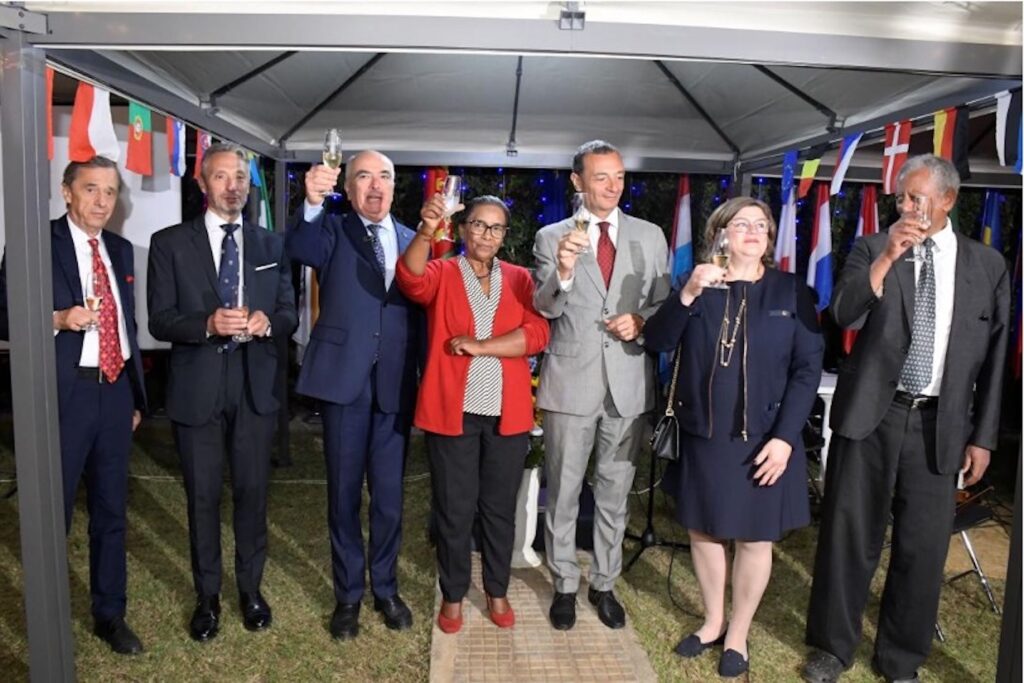
Eritrean leaders love to travel to attend international meetings abroad. They also enjoy celebrating “EU Week” in Asmara, toasting EU officials with champagne – all in support of “peace, security, prosperity and universal values”, according to the EU website. The EU’s policy towards Eritrea is currently focusing mainly on limiting irregular migration and securing its geostrategic objectives in the Horn of Africa, while the issue of human rights is increasingly relegated to the background. The Eritrean regime is probably also not holding its breath to see if the EU will ask Saudi Arabia to make at least part of its planned multi-billion investment in Eritrea’s Assab port facilities conditional on the release of political prisoners such as Dawit Isaak.
But what the Afwerki regime appreciates most is the Swedish government’s quarter century of consistent public silence. The fact that Sweden has neither been willing nor able to create significant international pressure on the Eritrean leadership, plus the fact that Eritrea has not incurred any meaningful costs for the continued serious crimes committed against a Swedish citizen, is remarkable and constitutes a shameful failure of both Swedish and international diplomacy.
“Silent diplomacy is a proper strategy in the early stages of difficult consular cases,” says Kjetil Tronvoll, Professor of Peace and Conflict Studies at Oslo New University College and a leading expert on Eritrea. “Some of these discussions need to be handled behind closed doors, others publicly. What strategies Sweden has tried in secret over the years is not known, but an international public ‘shaming campaign’ against the regime, combined with targeted EU sanctions, is lacking. This would also have the positive effect of counteracting the regime’s economic exploitation and transnational repression of the Eritrean diaspora,” Tronvoll adds.
Sweden and the EU now have a significant opportunity to seize the moment and break the current deadlock. Tronvoll also points out that Eritrea is dependent on support from Egypt (and other allies in the region) to deter Ethiopia from attacking the port of Assab. Sweden can use this fact to utilize Egypt’s influence over the Eritrean regime to secure Dawit Isaak’s release.
If Sweden really cares about its citizen, given the time Dawit Isaak has been imprisoned, his advancing age and the difficult prison conditions he has endured, there is not a second to lose.
Susanne Berger
Senior Fellow at the Raoul Wallenberg Centre for Human Rights
Caroline Edelstam
President and co-founder of the Edelstam Foundation